This is default featured slide 1 title

Go to Blogger edit html and find these sentences.Now replace these sentences with your own descriptions.

This is default featured slide 2 title

Go to Blogger edit html and find these sentences.Now replace these sentences with your own descriptions.

This is default featured slide 3 title

Go to Blogger edit html and find these sentences.Now replace these sentences with your own descriptions.

This is default featured slide 4 title

Go to Blogger edit html and find these sentences.Now replace these sentences with your own descriptions.

This is default featured slide 5 title

Go to Blogger edit html and find these sentences.Now replace these sentences with your own descriptions.

Pages

Jumat, 31 Oktober 2008

Understanding Southwest's Hedging

I don't normally pay much attention to the quarterly earnings reports of companies outside the energy sector, so I initially missed the confusion over the impact of fuel hedging on the third quarter results of Southwest Airlines. An article in yesterday's Washington Post brought this to light again, along with the effect of falling oil prices on the fuel hedging efforts of a diverse group of companies, including Coca Cola, Royal Caribbean Cruise Lines, and local heating oil distributors. The reporting on this subject illustrates two important points: commodities hedging is no free lunch, and understanding its full consequences requires more that a superficial look at the bottom line.

This morning I pored over Southwest's quarterly earnings press release to see what had happened. I was suspicious of the headlines suggesting that hedging had pushed Southwest into the red, because the average futures price of West Texas Intermediate crude oil for the quarter was $118 per barrel--hence ExxonMobil's record-breaking earnings--still well above the level at which Southwest was generally understood to have hedged its jet fuel. After some scrutiny, and to my considerable surprise, I concluded that both the Post and the Wall Street Journal in their earlier story on Southwest's earnings appeared to have misinterpreted some key aspects of the hedging results. Discerning that wasn't easy, since Southwest saw fit to report their earnings on both a GAAP (Generally Accepted Accounting Principles) and non-GAAP basis, and the intricacy of their "Reconciliation of Impact from Fuel Contracts" table forced me to jump-start some brain cells that have been dormant since my B-school financial accounting course.

Evaluating the benefit or cost of a hedge must include the result of the physical transactions it was intended to cover. In the case of Southwest, it appears that its unhedged fuel cost for the quarter--what it actually paid its fuel suppliers--was $1.387 billion. The hedges and related derivative contracts that settled in the quarter offset that by $448 million, reducing Southwest's effective fuel bill to $939 million. The problem that the Journal and Post focused on was related to future hedges, not those that unwound between July and September. Marking the company's total hedge portfolio to market resulted in an additional pre-tax cost of $247 million, reported as a special item. Factoring this in turned the company's modest operating profit of $69 million into a $120 million net loss, after tax. But it's not correct to say that hedging hurt Southwest. Had it not hedged at all, its after tax loss for the quarter would have been approximately $189 million, assuming it could have operated in the same manner. That seems unlikely, given the behavior of competitors with less active hedging programs.

But while the confusion over Southwest's earnings seems to arise from the requirement to recognize the reduced value of the future hedges still on its books as a loss to current income, this doesn't justify calls to set aside mark-to-market accounting. That special item should prompt investors to read the explanation Southwest has provided concerning its overall hedge portfolio, because it signals the prospect of further hedge-related losses in the future:

"In addition to our fourth quarter 2008 derivative position, we have derivative contracts for over 75 percent of our estimated 2009 fuel consumption at an average crude-equivalent price of approximately $73 per barrel; approximately 50 percent of our estimated 2010 fuel consumption at an average crude-equivalent price of approximately $90 per barrel; approximately 40 percent of our estimated 2011 fuel consumption at an average crude- equivalent price of approximately $93 per barrel; over 35 percent of our estimated 2012 fuel consumption at an average crude-equivalent price of approximately $90 per barrel; and have begun building a modest position for 2013."

That means that if oil prices remain between $60 and $70/bbl, then the effective cost Southwest will pay for jet fuel in future quarters could end up higher than that of competitors who didn't hedge or who hedged lower percentages of their expected fuel consumption than Southwest. Of course, that's not certain, either, because the price of oil might again rise above the level of their hedges.

The key to a successful hedging strategy is that companies shouldn't view it as a magician's hat out of which to pull larger profits, quarter after quarter. The benefit comes from reducing the volatility of earnings and enabling firms to continue operating more normally, when others have had to cut back drastically. Although this strategy could rebound on Southwest, if oil prices remain low for an extended period, falling prices may not hurt them as much as rising prices have hurt their less-hedged competitors, some of whom are now in a very poor position to capitalize on lower fuel costs.

Note: Energy Outlook will be on vacation next week, with postings resuming the week of November 10.

Rabu, 29 Oktober 2008

Iran's Oil Shield Slips

Between the US election and the gyrations of the financial markets, some important implications of the declining price of oil haven't received the attention they deserve. A case in point is the effect on Iran's geopolitical posture, particularly with regard to its nuclear program. Many articles have considered the impact of lower oil prices on that country's economy and its influence in the greater Middle East. However, as global demand for oil slows and its price sinks toward $60 per barrel, the effectiveness of Iran's implied threat to suspend oil exports in response to aggressive sanctions or a military strike on its nuclear facilities also erodes. This should create an opportunity for some very assertive diplomacy by the next administration, backed by a much more credible recourse to force. Given the progress of the visible parts of its nuclear program, this could be our last chance to prevent Iran from developing nuclear weapons.

A recent Washington Post op-ed by two former US Senators, one from each party, described the threat posed by a nuclear-armed Iran, along with a set of principles for addressing this challenge vigorously and promptly. Several years ago I took a detailed look at the rationale for Iran to build an entire nuclear fuel cycle for civilian purposes and found it wanting. The world's second-largest natural gas reserves provide it with a much more cost-effective means of generating additional power for its economy, without exposing the country to international sanctions or potential attack. Notwithstanding the findings of a controversial US National Intelligence Estimate last year, the simplest explanation for Iran's tenacity in pursuing uranium enrichment is the option that creates for building nuclear weapons. Nor has the International Atomic Energy Agency been able to gather enough information within Iran to rule out this scenario. This interpretation also aligns nicely with Iran's extensive work on ballistic missiles, which without the extreme accuracy of US missiles looks like a very expensive way to deliver conventional explosives.

Until recently, Iran has held all the cards. With the US focused on wars in Iraq and Afghanistan, Iran successfully played off Russia and China against other UN Security Council members that sought tougher sanctions to back up their diplomatic efforts to halt the nuclear program. And as oil prices went from high to astronomical, the consequences of a disruption in Iranian oil exports became increasingly unbearable and unthinkable for the US and the world economy. While still potentially quite disruptive and hardly to be invited lightly, that prospect looks much less dire today.

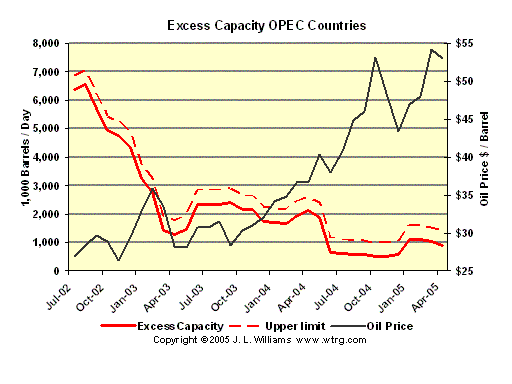
Iran exports a bit more than 2 million barrels per day (bpd) of oil. For most of the last four years, that quantity exceeded the sum of global spare oil production capacity, rendering Iran's contribution indispensable. That is no longer the case. Just last week OPEC announced production cuts that could cover all but 900,000 bpd of Iran's exports, with further cuts in prospect. Any shortfall beyond that could be made up from the US Strategic Petroleum Reserve, which could supply the difference for up to two years, if necessary. Oil prices would rise, though prompt releases from the SPR would limit the magnitude of any spike. In other words, if the Iranian government has assumed that the dreadful prospect of an Iranian oil embargo was sufficient to deter any measures strong enough to force them to give up their nuclear program, or to disable it on the ground, they should reconsider. Their ace-in-the hole looks more like a 10 or a Jack, today.

These altered circumstances should not be construed as providing a green light for air strikes on Iran's nuclear facilities. That option should remain a last resort, due to its many adverse consequences beyond oil. At the same time, because this and a number of less-violent steps suddenly look feasible, it might induce Iran to negotiate, prompted by the realization that it has more valuable things at stake than a uranium-enrichment program, including the health of an economy that is critically dependent on oil revenue and on imports of petroleum products that its own refineries cannot produce in sufficient quantity to satisfy domestic demand without rationing. While not exactly a silver lining of the present global crisis, this constitutes an opportunity that Western governments cannot afford to ignore, because its consequences will endure long after the present financial and economic problems have been resolved.

Senin, 27 Oktober 2008

Slowing Growth and Lower Emissions

Even before the global economy began to stumble, 2009 was set to be a milestone year for climate change policy. A new US administration will take office with a decidedly more pro-active attitude toward addressing climate change, and international negotiations are expected to culminate in a new agreement to replace the Kyoto Protocol, which expires in 2012. But while efforts to address climate change have always had to contend with their possible impact on the economy, we are receiving a vivid reminder that this relationship also works in reverse: a slowing economy will emit fewer greenhouse gases than if growth continued at previous rates, and the financial burden of emergency fiscal stimulus and capital injections will hamper governments' ability to dedicate large sums to addressing climate change.

This morning I was looking at the most recent oil market estimates from the International Energy Agency in Paris. In January the IEA had expected global oil demand for 2008 to average 1.7 million barrels per day (MBD) higher than in 2007, or +2%, exceeding the 1.5% growth in 2007 that had helped to push oil prices from the $50s into the $90s per barrel. As of October 10, however, their estimate for 2008 has fallen to 86.5 MBD, a scant 0.5% increase over last year. Nor do they expect growth to pick up much next year. Their current 2009 forecast is for an average of 87.2 MBD, down from 87.7 MBD in July, and growth will almost certainly fall further--perhaps below zero. We see the tangible echoes of these expectations in falling oil prices and in the 1.5 MBD production cut announced by OPEC on Friday.

Each million barrels per day of global oil demand equates to about 160 million metric tons of greenhouse gas emissions per year. The consequences of high oil prices and slowing economic growth have thus reduced 2008 emissions by around 200 million tons of CO2, and the OPEC cuts should take a comparable slice out of next year's emissions, with the total slashed by even more, when consumption of other fossil fuels is taken into account. Of course, this represents only about 0.5% of global GHG emissions, and it falls far short of the kind of reductions that climate experts have called for.

What can we conclude from this simple observation? First, it shouldn't surprise anyone that the relationship between economic growth and energy consumption--and hence emissions--should work in both directions. But simply cutting growth can't be a desirable way to tackle climate change, not least because the reduction in growth necessary to achieve the desired emissions levels would be catastrophic for both developed and developing countries. Nor are countries in deep recession likely to spend as much on environmental protection, notwithstanding all the recent euphoria about "green jobs." And if the pessimists are right, merely slowing our emissions growth won't even buy us time for improving our responses, because we've already passed the sustainable level of atmospheric CO2 concentration. If that's true, then no realistically-achievable climate treaty is going to solve the problem before it gets much worse.

Because I still view climate change in terms of risks and trade-offs, however, I see one bright spot in the current economic difficulties. With their governments and trans-national institutions such as the G-8, IMF and World Bank scrambling to forestall a global financial and economic collapse, the negotiators following the Bali Roadmap towards a new climate agreement to be announced in Copenhagen next December must focus on approaches that deliver the largest emissions reductions at the least cost, with the least damage to an already fragile economy. That seems likely to produce the most sustainable result, in any case, and thus the response that is best suited to endure the financial instability that the further progress of climate change, itself, could still deliver, on top of the boom-bust cycles of markets.

Kamis, 23 Oktober 2008

A Slower Green Shift?

The global financial crisis could not have arrived at a worse time for alternative energy. When I read the comments of many of my fellow bloggers concerning the implications of a recession for the near-term implementation of green energy, advanced technology vehicles, and action on climate change, the spectrum runs from denial to despair. This is understandable, considering how bright the green future looked when oil was on the threshold of $150 per barrel. The world has changed a couple of times this year, and the latest lurch does not very bode well for "cleantech", unless you are in the lemons-into-lemonade mold of The New York Times's Tom Friedman, who sees a "green buildup" as the basis for reviving the economy. With the media issuing moment-by-moment comparisons to the Great Depression and every other economic setback in the history of capitalism, it's easy to lose sight of the likelihood that however bad the next year or two might be, compared to the boom period that has just ended, the economy will recover, and with it, the driving forces that support the shift to cleaner, more efficient sources and uses of energy.

That could be small consolation for companies that have bet their future on a successful green product launch during the next two years. GM's Volt plug-in hybrid car comes immediately to mind. Even if GM survives long enough to complete its investment in mass-producing this "range-extended electric vehicle", the stars are lining up to impede its rapid market penetration. GM hasn't announced its sticker price, yet, but if it is close to the $40,000 figure that GM's Vice Chairman Bob Lutz mentioned earlier this year, then even after the federal tax credit of up to $7,500 for the first 250,000 plug-in hybrids, it would be a stretch for most consumers during a downturn in which car loan terms become stricter. Moreover, sub-$3 per gallon gas prices would stretch the car's fuel savings payout compared to a non-plug-in Prius into decades, rather than just years. The success of the 2010 Volt might depend on the looming recession being an average one, of less than a year's duration, rather than the deep and prolonged downturn that the media and the stock market appear to expect.

The timing of Honda's new Insight hybrid model looks somewhat better. Using a simpler hybrid system than either the Volt or the Prius, it is aimed at more price-conscious consumers. If, as expected, the Insight retails for under $20,000, it would deliver 40+ mpg hybrid performance at price that competes with such non-hybrids as the Ford Focus, or with VW's similarly-efficient Jetta TDI diesel, after tax credits. More radically, a slowing economy might be just what is required to sell not just new cars, but an entirely new model for selling mobility, such as the electric-vehicle-based approach of Better Place--assuming that it can be financed on the scale necessary to have an impact.

Savvy consumers and businesses should recognize that cheaper gas is much more likely to be short-lived this time than it was after the first energy crisis. While OPEC might struggle to cut production enough to defend a $60 or $70/bbl price in the short term, the current credit crunch is already sowing the seeds for slower production growth in the future, as smaller oil companies will be forced to scale back their exploration and production activities, and as national oil companies in Venezuela, Iran and elsewhere are forced to remit even more of their revenues to fund non-energy government programs, rather than their oil & gas capital budgets. That could set the stage for an even bigger oil price spike within a few years. Still, if you are worried about your job, or are struggling to keep up with your mortgage and home-equity loan payments, buying the greenest car on the planet might not be your highest priority for the near future.

Senin, 20 Oktober 2008

Candidates & Energy: McCain Revisited

Before delving into the details of Senator McCain's energy plans, it's worth noting how remarkable it is that our final choice should be between two candidates who view our energy and environmental challenges so similarly, even if their preferred solutions differ markedly, both in execution and in their underlying philosophy. It was not at all a forgone conclusion that the ultimate Republican nominee for President would consider climate change as a problem rivaling energy security, or that he would regard action on the former as a means of addressing the latter. Several of Senator McCain's challengers in the primaries appeared to view climate change as either a hoax or a nuisance issue. In essence, Senator McCain's proposals would create a transition plan for moving the US economy towards using much less imported oil, improving overall energy efficiency and reducing emissions. This would be achieved by ramping up domestic energy production, encouraging new energy and efficiency technology, and putting a market price on greenhouse gas emissions.

If you asked me for the single-sentence summary of the McCain energy plan, it would be nearly identical to one for the Obama Plan: "Make the US more energy independent and reduce greenhouse gas emissions through an emissions cap and trade system and other measures." The energy and climate sections of Senator McCain's campaign website mirror these priorities. Although it has gained considerable detail since I reviewed it in January, it remains less specific than Senator Obama's site. That no longer appears to be an omission, but rather a reflection of a profound philosophical difference in their approaches.

Where Senator Obama's energy plan relies heavily on mandates or incentives for specific technology pathways--electrified vehicles, for example--Senator McCain's emphasizes outcomes and offers incentives based on making progress towards them. For example, his Clean Car Challenge provides consumers with incentives for purchasing advanced technology vehicles based on the reduction of CO2 emissions they achieve, with zero-emission vehicles (tank-to-wheel) qualifying for a $5,000 tax credit. In addition to a tax credit for R&D, he proposes an X-Prize-like $300 million payoff for a quantum leap in vehicle battery technology. He would also end both the subsidy for domestic corn ethanol and the tariff on imported ethanol, forcing US ethanol producers to compete with other fuels, and particularly with more energy-efficient cane ethanol from Brazil and the Caribbean.

This emphasis on outcomes also applies to Senator McCain's approach to vehicle efficiency. Rather than calling for further increases in the recently-enacted 35 mpg Corporate Average Fuel Economy target for 2022, he has proposed strengthening CAFE enforcement by increasing the fines for missing the targets already in place--something that has received scandalously-little attention. This currently amounts to $55 per car for each mile-per-gallon below the standard. In 2006, for example, Daimler Chrysler paid $30 million in fines on 196,000 imported Mercedes Benzes, or $154/car. If CAFE is to be an effective tool for promoting fuel efficiency, rather than just measuring it, it must have sharper teeth than that.

Senator McCain's approach to climate change builds on the first cap & trade bill that he co-authored with Senator Lieberman in 2003 and reintroduced in the Senate in 2005 and 2007. His current version of this proposal would reduce US greenhouse gas emissions by 60%, compared to 1990 emissions, with milestone targets along the way. The first of these would see US emissions return to 2005 levels by 2012. That would make for a relatively soft transition, since 2006 emissions were below 2005's, and a slowing economy is liable to reduce them further. The gradual phase-in of auctioning for emissions permits would also ease the transition into this otherwise radical means of transforming the US energy economy. However, as I noted in my analysis of Senator Obama's plans, cap & trade would still function much like a tax on the entire economy, with potentially serious consequences during a major economic downturn. The odds of enacting and implementing such a system in the next two years have clearly diminished within the last month, no matter how high a priority either candidate deems climate change to be.

The most notable departure from Senator McCain's focus on outcomes, rather than specifying technology, involves nuclear power. He has described nuclear energy as a centerpiece of his energy security and climate change program and proposed building 45 new nuclear reactors in the US by 2030, with a target for eventually building 100 new plants--presumably to counteract the eventual retirement of most of the existing fleet of 104 reactors, some of which date to the early 1970s, with the newest having been completed in 1996. This is a very ambitious goal, and it represents one of the biggest differences between the energy plans of the two candidates. Senator McCain's confidence in nuclear power appears to rely as much on the decades-long experience of the US Navy with nuclear propulsion as on the current power reactor fleet that supplied 19% of all US electricity generated last year. Senator Obama has frequently expressed concerns about the safety, security, waste disposal and proliferation risks of nuclear power, and although he supports it in principle, it is not obvious that any of the nuclear plants for which permit applications have already been submitted would proceed in an Obama administration.

As helpful as more nuclear power plants would be for reducing the emissions that accompany our current reliance on coal-fired power plants, along with enabling truly zero-emission electric vehicles--as opposed to those that merely shift their emissions to a central power plant--nuclear is no quick fix. Considering that the only US nuclear power plant already under construction--following a 20-year hiatus--is not expected to start up until 2013, the 2030 timeline for achieving the 45-reactor goal looks just barely long enough. Perhaps that explains Senator McCain's emphasis on drilling for oil and gas in portions of the US currently off-limits to exploration, as a transition strategy to buy time for renewables and nuclear power to ramp up.

His support for expanded drilling covers the estimated 18 billion barrels of undiscovered potential oil resources and 77 trillion cubic feet of natural gas that were restricted by the recently-expired federal drilling ban, but it apparently does not extend to lifting the ban on drilling in the Arctic National Wildlife Refuge (ANWR.) While the mantra of "Drill Here, Drill Now" may seem overly simplistic, inclusion of conventional energy recognizes two key facts of our energy security challenge: The US still possesses enough remaining hydrocarbons to make a serious dent in our oil imports--though not to displace them entirely--and those hydrocarbons represent a concentrated and efficient energy source (in the energy return on energy invested in producing them, EROEI,) on a scale that renewable energy will not attain for years to come.

Although many of the elements of Senator McCain's plan look sensible, I still struggle with the notion of energy independence that underpins much of his--and Senator Obama's--energy strategies. Although Senator McCain has recently refined his goal of "strategic independence" to encompass backing out Middle Eastern and Venezuelan oil, we might get greater benefits from a more positive strategy of working with our natural hemispheric allies, such as helping Mexico revitalize its flagging energy industry and partnering with Brazil to develop its vast new oil finds, while we expand our own sources and use energy more efficiently. That would enhance energy security in a manner more consistent with the Senator's general espousal of free trade principles.

With regard to energy and the environment, voters face a difficult--and thus extremely fortunate--choice between two candidates who treat the energy crisis and climate change with the seriousness that these closely-connected issues deserve. The proposals of either one would move us much closer to a coherent and practical national energy policy, something that we have not had for far too long. At the same time, the differences in their approaches are significant and merit careful consideration. While Senator Obama's plans may depend too heavily on help from a federal government that could be over-extended by a number of other pressing concerns, Senator McCain's may rely too much on free market solutions that would be a tough sell in light of perceptions concerning the causes of the current financial crisis. And if elected, either one would find himself facing a powerful Congressional majority with its own ideas for solving these problems. The one certainty is that I will not lack for suitable topics on which to blog in 2009.

Jumat, 17 Oktober 2008

The New Oil Cycle

As of yesterday's close on the New York Mercantile Exchange, the price of crude oil has fallen 50% from its July high-water mark. The membership of OPEC must be experiencing an uncomfortable sense of déjà vu, recalling a similar drop between August 1997 and December 1998, when West Texas Intermediate (WTI) bottomed out at $10.72 per barrel, and the OPEC average price fell into single digits. The cost of production is much higher today than in the 1990s, so $10 oil is hardly in prospect, but even an extended period below $50 per barrel would cause severe pain to the oil industry and to anyone investing in alternative energy that competes with oil. However, while a return to $140 oil probably lies on the other side of a global recession, other structural changes could shorten the down-cycle, or at least put a relatively high floor under it, once the customary market overshoot has passed.

Previous oil-price cycles hold some useful insights into the likely bottom of the current cycle, but important differences are also apparent. The 1997-98 collapse was caused by a conjunction of events with strong parallels to today's situation. A wave of new oil projects collided with a sudden drop in global demand triggered by the Asian Financial Crisis. Producers faced a choice between cutting output and bearing unsustainable losses on every barrel sold, but their obvious response was complicated by two serious problems. Operators of mature oil fields employing secondary and tertiary recovery methods knew that once shut in, production might not return to previous levels, later. My former employer, Texaco, saw that happen at its century-old Kern River Field in California. Meanwhile, OPEC's members worried about a long-term loss of market share, similar to what occurred when demand for OPEC's crude fell by 44% between 1979 and 1985, requiring two decades to recover. It took an unprecedented coordination of production cuts between OPEC and Mexico, Russia and Norway--countries that might have otherwise capitalized on OPEC's unilateral cuts--to stabilize the market and nudge prices back into the $20s by mid-1999.

What's different today? Well, for starters, OPEC already has a working relationship with Russia, and the latter's output has stalled, while Norway and Mexico are both in decline. Meanwhile, OPEC has expanded to include Angola, formerly an important source of non-OPEC production growth. If OPEC cuts now, it's hard to see who would step in to steal their market share. The cartel has also enjoyed a better-than-normal degree of cohesion recently--always easier when you are producing essentially flat-out. Key producers such as Venezuela and Iran have seen first-hand the benefits of cutting a little to boost revenue a lot, and their economies depend on prices remaining near $100 per barrel.

Another important change since the late 1990s is the dramatic growth of Canadian oil sands output. The current production of 1.3 million barrels per day now constitutes a large fraction of the world's high-cost marginal supply. More than half of it comes from mining operations that could be slowed or temporarily halted with minimal impact on future output or ultimate reserve recovery. In other words, a drop in crude oil prices below the variable cost of producing synthetic crude from oil sands could be at least partly self-correcting, and fairly quickly.

Biofuels might end up in a similar position. With corn prices back down to around $4 per bushel and ethanol selling for an average of $2.22 per gallon at racks on Wednesday, the "crush spread", or gross margin for producers is around $0.80/gal, similar to where it has been for much of the year. But although ethanol had for most of the year been priced well under Gulf Coast gasoline, the sudden collapse of gas prices has inverted that relationship. With wholesale gasoline--specifically the RBOB mix designed for blending with ethanol--trading on the NYMEX at under $1.70/gal, and the ethanol blenders' credit falling from $0.51/gal to $0.45/gal on January 1, the incentive for refiners to blend more ethanol into gasoline than legally mandated is evaporating.

How quickly these factors could establish a hard floor under oil prices is anyone's guess, and I wouldn't be surprised to see WTI go well below $70/bbl before it corrects. This year's highs might have been helped along by a froth of speculation, but they were also what was required to destroy enough demand to bring a commodity with a low price-elasticity of demand back into balance with supplies that were straining at their near-term limits. That interpretation is also consistent with the dramatic fall in prices accompanying the current collapse of demand. But we can't forget that even if demand in the US and EU continue to shrink, thanks to conservation, efficiency, and alternative energy, the potential demand in Asia remains sufficient to outstrip global oil production capacity, once strong global economic growth resumes. Consumers should enjoy the relief from sub-$3.00 per gallon while it lasts, but they should not assume it will persist beyond the recession.

Rabu, 15 Oktober 2008

Candidates & Energy: Obama Revisited

The US Presidential election is now under three weeks away, after the longest campaign in living memory. Unsurprisingly, after several years of escalating oil prices, energy features prominently in the programs of both candidates, as does a response to growing concerns about climate change. Senator McCain and Senator Obama have spoken extensively on these issues, and both campaigns' websites feature lengthy discussions on US energy challenges and the possible solutions to them. Unfortunately, their ideas must be weighed in the context of a weakening economy and a federal budget deficit that may ultimately approach a trillion dollars per year. With their attention focused on the financial crisis and the shifting electoral map, it is not clear how much thought either campaign has devoted to reassessing their energy and climate programs in light of the changed circumstances in which the next administration will find itself. After flipping a coin, I will begin with Senator Obama and follow up with a review of Senator McCain's energy proposals within a week.

It seems appropriate at the start to remind my readers of this blog's determined non-partisan stance. My focus is on the candidates' energy policies and anything relevant to those, without making any endorsement. My goal is to provide my readers with insights on the energy aspects of these two candidates' proposals, including their pitfalls, based on my own perspective and experience. However important, energy is only one issue among the many upon which they should base their choice.

Senator Obama has a detailed, coherent energy plan, and his team has clearly spent a lot of time assembling and refining the energy proposals outlined on the campaign's website. Compared to the version I examined in January, during the primaries, the Senator's energy and climate framework has evolved and become more realistic. Although energy independence is still a major theme of Senator Obama's energy platform, his independence goal has become more specific and less ambitious. It is currently stated in terms of reducing our oil imports by an amount comparable to what the US receives today from the Middle East and Venezuela. That equates to around 3.3 million barrels per day, or roughly one-third of net US oil imports in 2007. As I noted recently, such a reduction just might be feasible, but not without a significant effort to ensure that US oil production does not continue to decline. Instead, Senator Obama appears to consider the US tapped out for oil, and apparently expects his energy independence goals to be met without more help from that quarter.

That assessment pervades his approach to the oil & gas industry, though recently he has described natural gas in more favorable terms. It is also consistent with his periodic citations of the "3% of reserves vs. 25% of consumption" soundbite, which drastically understates the remaining resource potential of the US. This may explain his 2006 vote against a modest expansion of the allowed drilling area in the Gulf of Mexico, and his restrained support for expanded access to oil & gas during this summer's Congressional debate on various drilling proposals.

If anything, he seems to regard the domestic oil industry not as a potential source of new supply, but as a source of new tax revenue. His short-term energy program leads off with one-time energy rebates--$1,000 per family or $500 per individual taxpayer--funded by a windfall profits tax on oil companies. He hasn't put a price tag on this, but assuming all taxpayers would be eligible, it would require on the order of $20 billion dollars per year in new taxes over the next five years. Although there are legitimate differences of opinion on the justification for such a tax, its consequences for future US oil output are unambiguous: what you tax more, you get less of. The most positive elements of the Senator's oil strategy feature some interesting ideas for extracting more oil from existing reservoirs through CO2 injection--simultaneously sequestering it. He also supports building a natural gas pipeline from Alaska to the lower-48.

With regard to climate change, Senator Obama shares my preference for an emissions cap with credit trading over a carbon tax. His version would be stricter than the one embodied in the Boxer-Lieberman-Warner Bill defeated earlier this year, with deeper cuts and auctioning of all credits. Although the latter reflects the view that partial auctioning in the EU's limited cap & trade system resulted in a windfall for emitting industries, it also increases the revenues that would be collected to well over $100 billion per year, based on current emissions and the likely cost of credits. The Congressional wrangling over how to spend the smaller windfall from Boxer-Lieberman-Warner was nearly enough to turn me against a policy I have promoted for nearly a decade. We also can't lose sight of the fact that, like a tax, cap-and-trade would raise energy costs for consumers and businesses. That may be a necessary evil, but it is still a fact that has received precious little attention in this campaign. If the price of emissions credits settles at the current European level, we would see gasoline go up by about $0.35/gal, and electricity prices rise by up to 3 cents per kilowatt-hour.

Nor would cap & trade supersede the existing system of selective incentives and tax credits. Initially, at least, it would be additive to these, and apparently also to Senator Obama's $150 billion plan to promote alternative energy technologies over the next 10 years, along with a new low-carbon fuel standard and a greatly-expanded federal biofuels mandate--from 36 billion gallons per year (BGY) by 2022 to 60 BGY by 2030. I still regard the 36 BGY target with its 21 BGY of cellulosic and other advanced biofuel as a stretch, since the first commercial-scale cellulosic biofuel plant has yet to start up. 60 billion gallons is beyond ambitious.

Not every element of Senator Obama's energy plan represents a departure from current policy. His proposal for a 4% per year improvement in Corporate Average Fuel Economy for vehicles is broadly consistent with the 35 mile-per-gallon fleet CAFE target for 2022 adopted in the Energy Independence and Security Act of 2007, and his proposed tax credit of up to $7,000 per car for plug-in hybrids and electric vehicles closely resembles the incentives included in the $700 billion rescue bill recently signed into law. And with regard to "clean coal", his approach seems similar to the Department of Energy's restructuring of its Futuregen program, earlier this year.

There is much to like about Senator Obama's positive vision of cleaner energy, focused on making America more self-sufficient. At the same time, it would impose the biggest and most intrusive changes on US energy markets since at least 1980, entailing the collection and redistribution of many hundreds of billions of dollars--not temporarily, as contemplated for the current federal intervention in financial markets, but on an effectively perpetual basis. The benefits of cutting our energy imports and greenhouse gas emissions to a more sustainable level would be significant, though if we are serious about reducing our reliance on unstable foreign oil suppliers, it is counter-productive to pit solar, wind and biofuels against domestic oil & gas, which today contribute roughly 30 times as much net energy to the US economy, and could do more. We may indeed be entering a new era of big government; however, while parts of the Senator's energy plan would stimulate new industries and new jobs, other portions would act as a drag on existing businesses, and on consumers. This may ultimately be necessary, in order to tackle climate change, but undertaking it during a recession would complicate efforts to revive the whole economy, not just its new green parts.