This is default featured slide 1 title

Go to Blogger edit html and find these sentences.Now replace these sentences with your own descriptions.

This is default featured slide 2 title

Go to Blogger edit html and find these sentences.Now replace these sentences with your own descriptions.

This is default featured slide 3 title

Go to Blogger edit html and find these sentences.Now replace these sentences with your own descriptions.

This is default featured slide 4 title

Go to Blogger edit html and find these sentences.Now replace these sentences with your own descriptions.

This is default featured slide 5 title

Go to Blogger edit html and find these sentences.Now replace these sentences with your own descriptions.

Pages

Tampilkan postingan dengan label oil market. Tampilkan semua postingan

Rabu, 17 Desember 2008

Oil Shock II

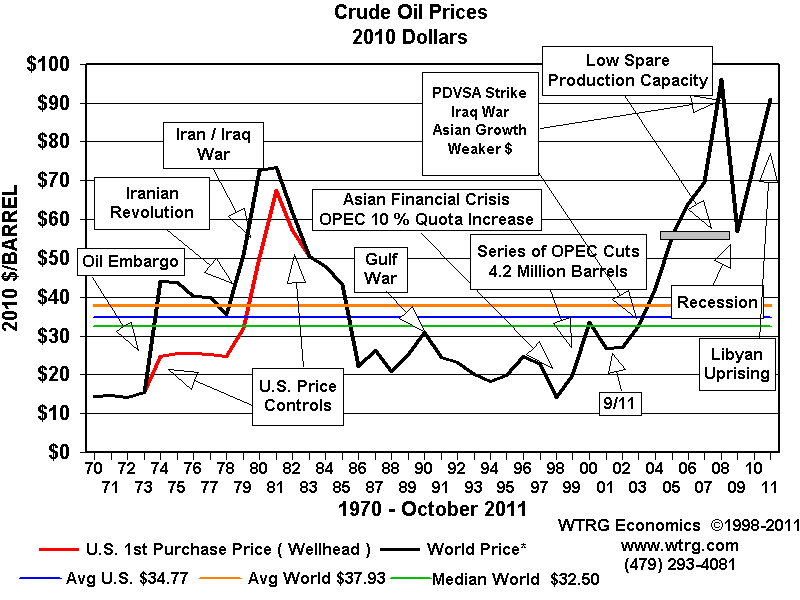
As OPEC's members and friends meet in Algeria to agree on deeper cuts in oil output, the effectiveness of their actions will depend greatly on the nature of the demand slump to which they are responding. If it proves to be merely a dip in the long-term growth trend, similar to the one associated with the Asian Financial Crisis of the late 1990s, then their current decline in revenue will likely be short-lived. If, on the other hand, the response in consuming countries is similar to that following the energy crisis of the 1970s and early 1980s, then OPEC and indeed all oil producers face protracted problems. In that case, they might have to hope that the chief economist of the International Energy Agency is correct in his new assessment that the credit crisis will hasten an expected peak in global oil production, perhaps sending oil prices beyond their summer 2008 highs within a few years.

Although the narrative concerning the present financial crisis and global recession is bound up in the collapse of the US housing market and the vast global debt bubble that fueled it--a bubble that had to burst sooner or later--it seems remarkably coincidental that it would begin to deflate just as oil prices raced past their previous inflation-adjusted peak of around $90 per barrel. Because that price rise took place over several years and was driven as much by demand as by supply constraints, the resulting oil shock wasn't as sharp or obvious as the one triggered by the Arab Oil Embargo of 1973 or the Iranian Revolution of 1979. But between 2003 and 2007, the US net oil import bill rose from around $100 billion per year to $300 billion, based on refiner acquisition costs. It crested at an annualized rate of $500 B per year in July. This added significantly to the US trade deficit, and the resulting sustained double-digit inflation in consumer energy costs helped push the annualized consumer-price inflation rate past 5% this summer. With the energy spike having folded, the November 2008 annualized CPI rate has fallen to 1.1%.

If in retrospect these indicators describe a true oil price shock, then what might OPEC and other oil producers expect in the years ahead? Well, in the aftermath of the last oil crisis, from 1979-83 global oil demand fell by 10%, the current equivalent of over 8 million barrels per day (MBD), based on last year's global consumption of 85.8 MBD. It didn't reach its 1979 level again until 1989. The effect on OPEC was devastating. With demand lower and non-OPEC output expanding steadily, OPEC's oil was squeezed out, losing a third of its former market share. Oil prices remained low for another fifteen years, contributing to the growth of the exurbs and the SUV fad.

History rarely repeats exactly, and it would be simplistic to think that we're likely to replicate the oil price environment of the mid-to-late 1980s. There's no tidal wave of non-OPEC conventional oil coming from places like the North Slope and North Sea, which looked technically challenging at the time but seem relatively easy, compared to today's opportunities. Biofuels have added the equivalent of around 0.5 MBD in the last several years, and Canadian oilsands a similar amount, but production in most non-OPEC countries is peaking or in decline, notably in Mexico and Russia. And as the IEA's Dr. Birol notes, tight credit and low prices will slow additions to supply from all sources, while natural decline erodes today's base production. That makes demand the crucial factor, particularly the behavioral elements of demand. Although rarely discussed in these terms, vehicle fuel economy faces diminishing returns. Boosting US fleet average miles per gallon from 13 to 25 under the original CAFE standard in the 1970s and '80s saved three times more fuel per mile than the mandated increase to 35 mpg will--in fact more than moving the entire fleet to 100 mpg plug-in hybrids would. Vehicle miles traveled have recently declined in the US. Along with the appetite of Asian consumers for their first cars, this will have as much impact as fuel economy on total oil consumption, and thus on prices.

Although the oil price shock of the last several years can't be blamed for the full extent of the mess we're in, it is at least a plausible candidate for the trigger that caused the debt bubble to pop now, rather than a few years from now. That has important implications, because current conditions may be setting the stage for another, possibly sharper oil shock shortly after the economy begins to recover. Although we face a drastically altered set of energy concerns going into 2009, energy policies that promote both conservation and increased supply look just as essential as they did a year ago.

Senin, 01 Desember 2008

The Right Price

So OPEC has kicked the can down the road another two weeks, deferring further production cuts until at least their December 17th meeting in Algeria, when they can better assess the impact of the cuts they've already made--code for observing how badly its members have cheated on their earlier quota reductions. As usual, the cartel's control over prices is much stronger when demand is surging and production capacity strained, than when markets develop considerable slack. This is a much-rehearsed dance, and the market has apparently already discounted it, with the price of light, sweet crude poised to test the $50 mark again this week. The more interesting commentary out of Cairo concerned OPEC's desired price, which is apparently $75 per barrel: well above today's level but far below summer's peak. Wishing won't make it so, but there has been much discussion lately about the "right" price for the most liquid of energy commodities.

I can't help observing the irony that $50 oil, the prospect of which seemed nearly inconceivable to seasoned industry experts only a few years ago, now looks too cheap, not just to OPEC, but also to producers of unconventional oil, developers and supporters of alternative energy, and those concerned about climate change. When you dig a little deeper, however, the insight here seems to be that the absolute price matters less than its volatility, at least from a planning perspective. It's hard for producers of all kinds of energy to plan their business, if the monthly average price of their output--or the key commodity affecting it--can spike up by 150% and then drop by 60%, all within the course of two years. Oil remains a cyclical business, as anyone who's been around it for a while understands, but this is ridiculous.

That $75 per barrel figure from OPEC is interesting for many reasons. It probably represents the minimum level needed to balance the considerable budgetary expansions taken on by its most aggressive spenders, such as Venezuela and Iran, along with pseudo-member Russia. But it also looks like the level that is required to keep additions of new unconventional oil capacity, such as Canadian oil sands, on track. With typical refining margins, instead of the bizarrely-inverted pricing we've seen recently, it would translate into an average gasoline pump price in the US of around $2.50/gal. And because US ethanol distillers are producing well beyond the volumes required to satisfy the federal Renewable Fuel Standard, that would yield an ethanol price after subsidies in the neighborhood of $2/gal., enough to give ethanol producers a 75 cent per gallon "crush spread" over corn at $3.50 per bushel. That's a lot better than the 40 cents or so implied by the current ethanol and corn futures prices.

If the drop to $50 were short-lived, most of those energy producers would experience little lasting impact, other than ethanol firms that have been pushed to the brink by the combination of overly-rapid expansion, tightening credit, and slumping prices. But looking ahead, no one can say with any certainty whether oil will remain here, test $40/bbl, or zoom past $100 again next summer. In this regard the futures market, which last week reflected prices above $70/bbl. beyond 2010, has been a very poor barometer. Nor have the forecasts of government departments or international agencies fared any better at anticipating the volatility that is so disruptive to economies and to the plans of energy companies and oil-exporting countries.

Consumers are in the best position of anyone affected by these developments. If you drive an average car an average amount, your fuel bills ought to be about $90 per month lower than they were in July, which is the equivalent of a $120 per month raise for anyone in the 33% combined federal income and social security tax bracket. Save it or spend it, but don't count on it lasting longer than a year. That means buying your next car with the prudent assumption that at some point in its life, you will be paying $4 or more per gallon, once again.

Kamis, 21 Agustus 2008

Defining Speculation

Oil market speculation is back in the news, because Vitol S.A., one of the world's largest oil-trading firms, has apparently been re-classified as a "non-commercial" market participant by the Commodity Futures Trading Commission (CFTC). That marks them as a speculator, this year's scarlet letter. Before we pass judgment on the influence of such firms on the price of oil, and thus on the petroleum products consumers buy, it's worth considering what we really mean by speculation, and how this might be distinct from the activities of the participants that the CFTC deems "commercial", i.e. those conducting futures, options and swap transactions in conjunction with their physical production or consumption of various forms of energy. More importantly, we should evaluate whether speculation is an important enough factor in the oil market to merit distracting us from the urgent pursuit of solutions that would expand energy supplies and shrink demand.

As big as they are, Vitol hardly fits the profile of the kind of speculators that stand accused of driving up the price of oil and everything connected to it to unprecedented levels. Vitol has been trading oil since the 1960s, and I did my first deal with them in the 1980s, when I traded petroleum products for Texaco's West Coast refining and marketing subsidiary. I got a much better sense for just how large a player they were in the physical markets for oil, feedstocks and refined products when I traded international products in London in 1989-91. There were few markets in which Vitol didn't participate, and a few niches that they dominated. Although I haven't had any contact with them in at least 14 years, their growth during that interval has been impressive. So I was hardly shocked to learn that they had apparently accounted for a significant fraction of the open interest in crude oil on the New York Mercantile Exchange (NYMEX) earlier this year. Any non-producer transacting the volumes of physical oil and products deals they do could not manage their business properly without extensive use of futures, options and over-the-counter swaps, little of which could fairly be called speculation.

Texaco's trading division had very firm rules about speculation on futures or options, which it defined as long or short positions that weren't directly linked to a like quantity of physical oil or products we were buying, selling, or holding in inventory, contemporaneously. Even for a group focused on "wet" cargoes--actual liquids on ships, barges, or in pipelines--that was sometimes limiting, because it meant we had to do the physical transaction first, and then scramble to hedge it. But while we couldn't take "naked" long or short positions in the market, we could transact "spreads" that were basically bets on some aspect of the market, such as a widening or narrowing of the price difference between futures contract months, or between different products, or different locations. While we weren't speculating on the absolute price, risking large swings in profit and loss, we were certainly risking smaller amounts on these other market attributes. I think most people would consider that speculation, since we didn't have to do it to support our physical trading or the company's much larger producing and refining businesses. But aside from some modest, inconsistent profits it gave us insights into market trends that passive observers don't usually gain: if you really want to understand a market, you have to be in the market.

Now consider Vitol, buying and selling oil and product cargoes all over the world and owning interests in oil terminals on three continents, a few oil fields, and a small refinery in the Persian Gulf. That doesn't put them in the same league as ExxonMobil--which, unless things have changed a great deal since the Exxon-Mobil merger in 1999, doesn't trade on the NYMEX at all--or legitimize every position they take as non-speculative. However, it's a far cry from the stereotypical view of asset-class commodity speculation by pension funds and hedge funds, executed by twenty-somethings who wouldn't know an octane from an antelope. That's important, because long-established oil trading firms like Vitol have institutional memories that span many up and down cycles of the oil market and know that a trend can turn when you least expect it. It doesn't mean they wouldn't risk a big loss to make a big profit, but in my estimation it makes them poor candidates to be the driving force behind a wave of speculation perceived to have pushed the price of oil beyond the level that could be explained by the fundamentals alone.

The roughly 20% drop in oil prices since the beginning of July should calibrate our estimates of the influence of such speculation. It was clearly not sufficient to maintain momentum in the face of weakening fundamentals of demand, supply and risk. At the same time, our response ought to distinguish between the kind of speculation represented by oil market neophytes hoping to cash in on an attractive investment trend, and the speculation that is an absolute requirement of a smoothly-functioning commodities market. Anyone who thinks the oil market would work just fine with only producers, refiners and end-users has never spent a day trading, or seen liquidity vanish just when a specific transaction was most desirable or necessary, because there was no middleman willing to take it on as a bet. But regardless of whether one variety of speculation should concern us more than another, the market's dramatic response to sliding demand serves notice to policy makers that their best and most productive avenue for addressing the impact of high oil prices is surely prompt and meaningful action on supply and demand, rather than rounding up today's version of the usual suspects.

Senin, 11 Agustus 2008

Oil in the Crosshairs

For the last several years, the oil market has focused on the risk of a new conflict in the Persian Gulf, evolving from earlier fears of a direct US/Iranian confrontation to recent worries that Israel might attack Iran's nuclear program. I suspect that little of that oft-cited "risk premium" was devoted to the chances of a shooting war breaking out in the Caucasus, virtually on top of a key oil export route from the Caspian Sea. Yet here we are, with Russia intervening Friday on behalf of one of Georgia's breakaway regions, South Ossetia, and bombs apparently falling near the Baku-Tblisi-Ceyhan Pipeline (BTC) that carries oil to the Mediterranean from the giant "ACG" oilfields of Azerbaijan. If the pipeline, which suffered an unrelated fire last week, were forced to shut down for an extended period, about 1% of the world's oil production could go off line, at least until some portion of it could be re-routed. The market shrugged off this prospect initially, with WTI falling $5 to end last week at $115. I would be surprised if the reaction this week proved quite so blasé.

Georgia was occupied by Russia for nearly 200 years prior to the collapse of the USSR, and the Caucasus is at least as strategic today as it was in the time of the czars, considering its role in the transit of the hydrocarbon resources of the Caspian Sea region. Prime Minister Putin, who appears to be calling the shots in this matter, likely regards Georgia as a rightful part of Russia's sphere of influence, but that doesn't give us many clues about the true extent of Russia's war aims. Given the preparations apparent in the current offensive, these could extend to annexation of South Ossetia into the Russian Federation, regime change in Tblisi, or merely putting a good scare into any former Soviet territories flirting with the idea of NATO membership. Although Russia was hardly pleased with the selection of an export route for Caspian oil that deliberately avoided its territory and control, and has gone to great lengths to regain state control over its own oil industry, oil isn't necessary to explain the events in Georgia.

Unfortunately, the implications for oil supplies go beyond the immediate disruption of the roughly 800,000 bbl/day the BTC line was carrying prior to last week's accident. In its latest Oil Market Report, the International Energy Agency cited expected additions to Azeri production of 200,000 bbl/day this year and a like quantity in 2009. As tightly balanced as the oil market remains, with demand destruction largely responsible for the current slump in prices, it would be bad news if those extra supplies could not be accommodated via the BTC or other export routes. Even if the Caspian hasn't quite delivered the oil gusher some expected a decade ago, it is one of a small number of regions in which production trends have been going the right way.

Whoever threw the first punch--and so far neither side seems terribly credible concerning this--the timing of the conflict favors Russia's attaining its goals in this affair. The combination of high energy prices and a highly-distracted America shrinks the odds that either the US or EU will take on Russia in defense of a former Soviet republic, beyond issuing statements asking Mr. Putin to respect Georgia's territorial integrity. Even if the BTC pipeline survives unscathed and quickly resumes deliveries, political risk in the entire region has increased, and future development from this crucial non-OPEC source could slow. That would keep oil prices higher, for longer than otherwise. With roughly $300 billion per year in oil export revenues at current prices, Russia sits near the top of the list of beneficiaries from such an outcome.