This is default featured slide 1 title

Go to Blogger edit html and find these sentences.Now replace these sentences with your own descriptions.

This is default featured slide 2 title

Go to Blogger edit html and find these sentences.Now replace these sentences with your own descriptions.

This is default featured slide 3 title

Go to Blogger edit html and find these sentences.Now replace these sentences with your own descriptions.

This is default featured slide 4 title

Go to Blogger edit html and find these sentences.Now replace these sentences with your own descriptions.

This is default featured slide 5 title

Go to Blogger edit html and find these sentences.Now replace these sentences with your own descriptions.

Pages

Tampilkan postingan dengan label exxon. Tampilkan semua postingan

Jumat, 06 November 2009

Cheap Oil

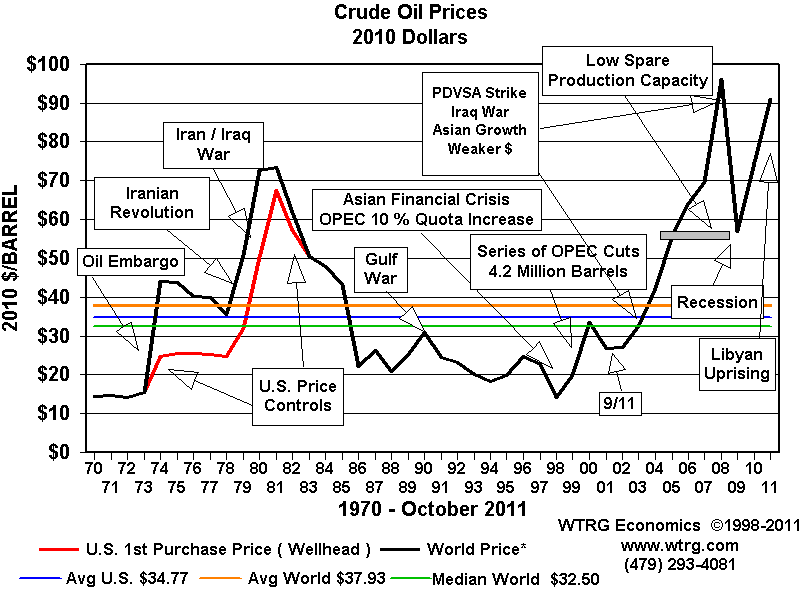
When the US invaded Ba'athist Iraq, many ascribed that action to a desire to seize the country's vast oil reserves and develop them on terms favorable to us, presumably to keep the days of cheap oil rolling on. After six years of oil prices far above their pre-war level, the last vestiges of that theory should be laid to rest by a careful reading of today's headlines concerning the announced production deal between the Iraqi government and ExxonMobil and Shell. The terms looks anything but lucrative for the Supermajors, which have won the opportunity to revamp output at one of Iraq's largest mature oil fields, West Qurna. However paltry the returns might look for the firms involved, this development could have a bigger impact on oil price--and sooner--than some of the splashier recent announcements concerning big oil finds off Brazil and West Africa.

The reported terms of the deal struck by Exxon and Shell in Iraq continue the trend of allowing access only on the basis of working as contractors, rather than as partners with an ownership interest in the underlying resource via a typical production-sharing contract. According to the story in today's Wall St. Journal, the companies will receive just $1.90 per barrel for their efforts to boost the flagging output of the super-giant West Qurna field, the output of which could increase by more than the current oil production of Texas (including the Gulf of Mexico.) Moreover, because the project entails virtually no exploration risk--the reserves are well-established--and minimal technical risk, and is already connected to infrastructure, the only real limitation on how fast it could begin ramping up is the local security environment and the ability of the firms to line up equipment and workers. This will still require several years, but it should happen a lot quicker than the time required to develop a new field with tricky geology in deep water.

So what does this mean? Well, for ExxonMobil and Shell it offers a relatively quick boost in production and revenue. $1.90/bbl is skimpy compared to what companies can make on their own discoveries, but over volumes this large it could translate into an extra $700 million of annual cash flow for the next 20 years. As attractive as that sounds, though, it comes without the ability to book new reserves, which are so critical to the valuations of oil companies.

The implication for oil prices will depend on many other factors, but the steady growth of Iraq's oil production from the current 2.5 million bbl/day to a level commensurate with the country's reported 115 billion bbls of reserves could at least compensate for some large declines elsewhere and help maintain a reasonable cushion of spare production capacity as the global economy gets back on track. This hardly bodes a return to $20 oil prices--an eventuality that would be much less welcome in the carbon-constrained world we're entering than just a few years ago--but it could buy us enough time for fuel efficiency and vehicle electrification to match Peak Demand to an inevitable peak in global production.

Kamis, 23 Juli 2009

Big Algae?

In spare moments during the last week I've been mulling over the implications of ExxonMobil's announcement of a very large investment in research and development on producing biofuels from algae, in collaboration with a leading biotech firm, Synthetic Genomics, Inc. While the reported figure of $600 million wouldn't buy much in the way of actual deployment, it could sure pay for a heck of a lot of R&D. The joint conference call about the announcement emphasized that the companies will be pursuing several possible technological pathways, though all appear to be focused on producing biofuel from algae continuously, rather than in a batch mode more analogous to farming. That would certainly increase the attractiveness for Exxon, which after all operates some of the world's biggest continuous production processes, in the form of its oil & gas fields, refineries, and chemical plants. The timing of this announcement is also interesting, coming just a few weeks after the US House of Representatives passed the first cap & trade bill to make it through either chamber of Congress.

The fundamental question I've been pondering is "why"? Why algae, and why ExxonMobil? For all of algae's enormous potential to produce large quantities of useful fuel, skepticism that this could ever be done economically on a useful scale abounds. And until now, Exxon had made a virtue of avoiding investments in renewable energy, generally seeing them as delivering returns well below those of the large oil & gas projects that have earned Exxon a sterling reputation for capital discipline. The answer to both questions likely resides in a word that appears frequently in the press release, in news coverage of the announcement, and in the press conference: scale. Two aspects of scale are relevant, here. First, in order to contribute meaningfully to our energy and climate problems, an alternative energy technology must be capable of being scaled up rapidly to a level comparable to today's oil, gas and coal industries. Current biofuels, solar power and wind still don't come close to matching the energy delivery of conventional sources. Exxon's website indicates potential liquid yields from algae of 2,000 gallons per acre, presumably in the form of the hydrocarbon-based "biocrude" emphasized repeatedly in the press conference. Even that relatively conservative estimate--my own back-of-the-envelope upper-bound estimate was 6,000 gal./acre--is at least ten times the current US yield of corn ethanol, after adjusting for energy content. Simplistically, if the acreage currently devoted to growing corn for ethanol were devoted to oil-excreting algae, it could replace nearly 60% of our gasoline supply from crude oil, rather than the 5% or so we get from ethanol.

Scale is also crucial for a firm of Exxon's size. A report in today's Wall St. Journal caught my eye. Occidental Petroleum announced its discovery of a 200 million barrel onshore oilfield in the middle of one of the most mature oil provinces in the world, in the San Joaquin Valley of California. I know that territory very well from my oil trading days, and it's an exciting development. However, Exxon is so big that it must find the equivalent of 8 such fields every year, just to stay even with its production. When I listen to the way Exxon describes its algae investment, I get the distinct sense that it views this arrangement as analogous to a very large oil exploration project, one that would be material to the results of the largest oil SuperMajor--and perhaps with similar odds of success. Now, it would be meaningless and of no value to Exxon if algae could produce the equivalent of hundreds of thousands of barrels per day of oil, but at a cost of $1,200/bbl. Exxon appears to be convinced that algae can contribute at a price very close to today's hydrocarbons, and probably without subsidies, knowing the firm's distaste for them. That has implications beyond algae.

In the conference call, Exxon's VP of R&D indicated that the company had assessed all of the advanced biofuels technologies and concluded that algae offered the best hope for producing fuels that would compete economically, with acceptable environmental impacts. That says something very worrying about the near-term prospects for cellulosic ethanol and the other "second-generation" biofuels technologies on which companies such as BP, Shell, and many others have pinned their hopes. Indeed, the US Congress pinned the whole country's hopes on the prompt commercialization of these unproven technologies in the remarkably ambitious national Renewable Fuels Standard they enacted in late 2007. If Exxon has concluded correctly that algae--which faces many serious hurdles of its own--is the best bet, then the entire US alternative fuels strategy could be in trouble.

There is also another way to look at this announcement. Exxon has been under enormous pressure to take a big stake in renewable energy. I vividly recall a Congressional hearing last year when committee chairman Ed Markey (D-Mass.) berated and belittled the Exxon representative for doing so little in this area. More recently, an environmental group took out full page ads targeting Exxon's opposition to cap & trade. I can't find the ad on the internet, but it said something like, "Poor Exxon, all alone in opposing Waxman-Markey." That has to get old, even for Exxon.

Could the algae tie-up with Synthetic Genomics, with its impressive expenditures contingent on achieving a series of unspecified milestones, be intended mainly to get this particular monkey off their backs? I doubt it, even though all the other advanced biofuel technologies being touted by their promoters also involve a substantial element of PR, until they actually produce commercial outcomes. If Exxon merely wanted to create some "green cred", it could have taken the same money and bought a dozen bankrupt corn ethanol plants or a few medium-sized wind farms. If the Exxon/Synthetic Genomics collaboration is about making Exxon greener, then it is certainly doing it the Exxon way, investing in something that, if successful, would neatly and profitably slot into their existing business model--and by the way into the hundreds of existing refineries and hundreds of millions of internal combustion engine vehicles globally. It's probably too early to imagine Big Oil becoming Big Algae, but the possibilities have obvious appeal, apparently even for the world's most successful oil company.

Kamis, 21 Agustus 2008

Defining Speculation

Oil market speculation is back in the news, because Vitol S.A., one of the world's largest oil-trading firms, has apparently been re-classified as a "non-commercial" market participant by the Commodity Futures Trading Commission (CFTC). That marks them as a speculator, this year's scarlet letter. Before we pass judgment on the influence of such firms on the price of oil, and thus on the petroleum products consumers buy, it's worth considering what we really mean by speculation, and how this might be distinct from the activities of the participants that the CFTC deems "commercial", i.e. those conducting futures, options and swap transactions in conjunction with their physical production or consumption of various forms of energy. More importantly, we should evaluate whether speculation is an important enough factor in the oil market to merit distracting us from the urgent pursuit of solutions that would expand energy supplies and shrink demand.

As big as they are, Vitol hardly fits the profile of the kind of speculators that stand accused of driving up the price of oil and everything connected to it to unprecedented levels. Vitol has been trading oil since the 1960s, and I did my first deal with them in the 1980s, when I traded petroleum products for Texaco's West Coast refining and marketing subsidiary. I got a much better sense for just how large a player they were in the physical markets for oil, feedstocks and refined products when I traded international products in London in 1989-91. There were few markets in which Vitol didn't participate, and a few niches that they dominated. Although I haven't had any contact with them in at least 14 years, their growth during that interval has been impressive. So I was hardly shocked to learn that they had apparently accounted for a significant fraction of the open interest in crude oil on the New York Mercantile Exchange (NYMEX) earlier this year. Any non-producer transacting the volumes of physical oil and products deals they do could not manage their business properly without extensive use of futures, options and over-the-counter swaps, little of which could fairly be called speculation.

Texaco's trading division had very firm rules about speculation on futures or options, which it defined as long or short positions that weren't directly linked to a like quantity of physical oil or products we were buying, selling, or holding in inventory, contemporaneously. Even for a group focused on "wet" cargoes--actual liquids on ships, barges, or in pipelines--that was sometimes limiting, because it meant we had to do the physical transaction first, and then scramble to hedge it. But while we couldn't take "naked" long or short positions in the market, we could transact "spreads" that were basically bets on some aspect of the market, such as a widening or narrowing of the price difference between futures contract months, or between different products, or different locations. While we weren't speculating on the absolute price, risking large swings in profit and loss, we were certainly risking smaller amounts on these other market attributes. I think most people would consider that speculation, since we didn't have to do it to support our physical trading or the company's much larger producing and refining businesses. But aside from some modest, inconsistent profits it gave us insights into market trends that passive observers don't usually gain: if you really want to understand a market, you have to be in the market.

Now consider Vitol, buying and selling oil and product cargoes all over the world and owning interests in oil terminals on three continents, a few oil fields, and a small refinery in the Persian Gulf. That doesn't put them in the same league as ExxonMobil--which, unless things have changed a great deal since the Exxon-Mobil merger in 1999, doesn't trade on the NYMEX at all--or legitimize every position they take as non-speculative. However, it's a far cry from the stereotypical view of asset-class commodity speculation by pension funds and hedge funds, executed by twenty-somethings who wouldn't know an octane from an antelope. That's important, because long-established oil trading firms like Vitol have institutional memories that span many up and down cycles of the oil market and know that a trend can turn when you least expect it. It doesn't mean they wouldn't risk a big loss to make a big profit, but in my estimation it makes them poor candidates to be the driving force behind a wave of speculation perceived to have pushed the price of oil beyond the level that could be explained by the fundamentals alone.

The roughly 20% drop in oil prices since the beginning of July should calibrate our estimates of the influence of such speculation. It was clearly not sufficient to maintain momentum in the face of weakening fundamentals of demand, supply and risk. At the same time, our response ought to distinguish between the kind of speculation represented by oil market neophytes hoping to cash in on an attractive investment trend, and the speculation that is an absolute requirement of a smoothly-functioning commodities market. Anyone who thinks the oil market would work just fine with only producers, refiners and end-users has never spent a day trading, or seen liquidity vanish just when a specific transaction was most desirable or necessary, because there was no middleman willing to take it on as a bet. But regardless of whether one variety of speculation should concern us more than another, the market's dramatic response to sliding demand serves notice to policy makers that their best and most productive avenue for addressing the impact of high oil prices is surely prompt and meaningful action on supply and demand, rather than rounding up today's version of the usual suspects.