This is default featured slide 1 title

Go to Blogger edit html and find these sentences.Now replace these sentences with your own descriptions.

This is default featured slide 2 title

Go to Blogger edit html and find these sentences.Now replace these sentences with your own descriptions.

This is default featured slide 3 title

Go to Blogger edit html and find these sentences.Now replace these sentences with your own descriptions.

This is default featured slide 4 title

Go to Blogger edit html and find these sentences.Now replace these sentences with your own descriptions.

This is default featured slide 5 title

Go to Blogger edit html and find these sentences.Now replace these sentences with your own descriptions.

Pages

Jumat, 01 Agustus 2008

Petro Profits

This energy crisis has given rise to a new American ritual: every quarter, after ExxonMobil's earnings are announced, the media breaks them down into dollars per hour, minute and second, and then cues to reaction shots of consumers expressing outrage that any company should benefit so much from their pain at the gas pump. Although I'm not suggesting we should all feel warm and cozy about oil company profits, we might be better served to focus our fulminating on the dog that doesn't bark. If the largest US oil company produces only 3% of the world's oil and still made nearly $12 billion last quarter, what did the national oil companies that own most of the world's oil make, and who paid for that?

Considering the average price of oil in the 2nd quarter, no one should be surprised that Exxon had stellar results, in spite of earning 54% less on refining and marketing and a third less on chemicals than they did last year at the same time. Allocated over the 26 billion gallons of petroleum products they sold around the world in the quarter, these profits equate to an average of 45¢ per gallon, with 87% coming from finding and producing the oil that went into making those products. It's not unreasonable for consumers paying roughly $4 per gallon to grouse about that, though it does say something about our current national mood that the media chooses to highlight that reaction, rather than someone seeing the results enjoyed by Exxon's shareholders and wanting a piece of the action, no matter how small. But whatever the US oil companies, including Chevron, ConocoPhillips, Marathon, and numerous others make, at least most of their profits get recycled into the US economy, in the form of new investments and the savings and spending of the millions of us who collect their dividends, directly or indirectly. The same can't be said for the profits of Saudi Aramco, the National Iranian Oil Co. (NIOC), Kuwait Petroleum Co., PdVSA, Rosneft, and so on.

Consider NIOC, the second-largest producer among national oil companies, at 4.15 million barrels per day, about 60% of which is exported. Iran is a relatively low-cost producer, though probably not as low as Saudi Arabia. If their total costs per barrel averaged more than $15 per barrel, I'd be surprised. So at an average price for Iranian Heavy for 2Q08 of $113.85/bbl., that works out to a quarterly gross profit just on exports in the neighborhood of $22 billion, excluding NIOC's earnings from domestic sales, refining and its substantial production of natural gas. Those might add another $10 billion to the total. Lop off a billion or so for overhead, and NIOC is probably reporting to its sole shareholder second-quarter results north of $30 billion. That'll buy a few centrifuges.

So go ahead and grumble about big US oil companies making record profits, while we pay near-record prices at the pump. But don't forget that we import 12 million barrels per day of oil and petroleum products, for which each and every quarter we must send roughly $135 billion outside the country, at current prices. Mr. Pickens is right to bemoan this enormous and unsustainable transfer of wealth. In that context, a smart national energy policy would not bog down in trying to choose among expanded drilling, conservation, and renewable energy, as though these were mutually exclusive options; it would pursue all of them, vigorously, and without vilifying companies for wanting to produce more energy here in the US.

Rabu, 30 Juli 2008

Offsets and Behavior

It took a while for US petroleum product demand to respond to high oil prices, but once gasoline neared $4 per gallon in a slowing economy that no longer afforded consumers the opportunity to translate home equity appreciation into purchasing power, it set up the first absolute decline in gasoline use since 1991. But would this response have been so dramatic, if the majority of consumers had already locked in their fuel costs, or hedged them financially? That question has interesting parallels with regard to climate change, for which emissions offsets can provide individuals with a cost-effective temporary alternative to more difficult or expensive changes.

Having just received a renewal notice from my emissions-offset provider, it seemed like a good time to recap my family's fuel consumption for the past year, in order to calculate how much CO2 our two cars emitted. I won't pretend the Styles household is typical in its gasoline consumption. Since neither adult commutes to work, we drive less than the national average. That's just as well, since our cars' fuel economy is nothing special: the station wagon and the sports sedan both get around the national average fuel economy of roughly 22 mpg. Together they consumed 705 gallons of gasoline in the last 12 months.

Tallying our fuel use also provided an opportunity to assess the actual impact of higher fuel prices on our family budget. At an average price increase since last July of 63 cents per gallon, we spent $450 more on gasoline than in the previous year. Although that result fell short of my perceptions, it still represents money we could have spent on other goods and services, or saved. Yet I also knew I couldn't view it isolation, without considering the impact of the natural hedge provided by the oil company stock I retain as a result of my previous employment. Although its performance has been disappointing since oil began its retreat from $145 per barrel, over the last four years it has more than offset the approximately $2 per gallon increase in fuel prices we've experienced. But that isn't just a benefit of being an ex-oil company executive; anyone could have created such a hedge, if they had a spare few thousand dollars to invest.

Four years ago the average US price for regular gasoline stood at $1.90 per gallon. This week it's $3.95. Although its rise has hardly been smooth, that works out to roughly an extra 50 cents per gallon each year, compounded. For a typical car consuming 500 gallons per year, that equates to a cumulative fuel-expense increase of $2,500 over the entire period. As it turns out, $2,900 invested in a fund tracking the Amex Oil Index (XOI), a basket of oil equities, on August 1, 2004 would have grown to $5,750 by now, enough to cover the entire increase in gasoline prices and still pay a 3% return on the principal, though not without significant risk and volatility. Since oil equities are hardly a perfect proxy for fuel prices, a bolder investor might have achieved the same hedge by investing directly in a commodity fund. Alternatively, anyone lacking the capital or the inclination to tie it up this way could have locked in his or her gas purchases using a service such as MyGallons.com. (I haven't tried it and can't vouch for it in any way; caveat emptor.) And never forget that hedges can lose money; if you hedge but the price falls, you will be worse off than if you had done nothing.

Even without our natural hedge, I doubt that we'd seriously be considering trading in our pair of 4-year-old cars on new, more efficient models, in order to save that $450 per year. We don't drive enough to justify taking the resulting hit on depreciation, even if we doubled our fuel economy. Nor does our desire to reduce our greenhouse emissions alter that calculation by much. The gasoline we've burned since last July produced 7 tons of CO2. Based on the rates charged by TerraPass, we can offset that for $83.30, getting us effectively to zero emissions, rather than the reduction of 1/3 to 1/2 we might expect from newer, thriftier cars--and at a much lower cost.

Now, I've heard all the arguments about "buying indulgences" instead of making real changes in our lifestyles. Although my family has effectively negated the personal impact of higher oil prices and our vehicles' CO2 emissions, the world as a whole might be better off if we had bought a pair of hybrids, instead. However, that argument contains two fallacies, one arising from the inappropriate application of a pollution mindset to greenhouse gases, and the other reflecting the limited supply of highly fuel-efficient cars and the benefit of allocating them first to the highest-intensity users. As long as my offset provider is really investing in projects that truly reduce emissions--emissions that are equivalent in impact regardless of where on the planet they occur, and that wouldn't be cut otherwise--then for less than $100 per year we have the climate equivalent of two EVs running on wind power, minus their cachet. And we aren't competing for a hybrid with someone who drives 20,000 miles per year.

That isn't an excuse for perpetual indulgence, of course. When we do buy new cars, they will be much more efficient: diesels or hybrids, at least. And if the US hasn't enacted economy-wide cap & trade or carbon taxation by then, we'd pay to offset the remaining emissions. Similar calculations by millions of Americans may help to explain the fuel economy inertia of the US vehicle fleet, and why it will only improve incrementally within the next five years, no matter how efficient the new-car fleet becomes.

Senin, 28 Juli 2008

NIMBY vs. TANSTAAFL

It is encouraging that our reaction to the current energy crisis has reached the stage at which we are beginning to see concrete plans for addressing it systematically, rather than via the grab-bag approach employed in last year's energy bill. The same applies to the related, but not quite parallel problem of climate change. But whether voters ultimately gravitate towards the Pickens Plan or to Mr. Gore's more dramatic goal of eliminating fossil fuels, such approaches are likely to run afoul of the same factors that have hampered the ability of the US conventional energy sector to keep pace with demand. Real progress in this area will require us to confront the collision between our desire for abundant energy and our distaste for the means of providing it.

The current debate over offshore drilling exemplifies many of the same obstacles that renewable energy sources will face, as we attempt to scale them up to a level that can compete with oil, gas and coal. Too many advocates of alternative energy cite our inability to drill our way out of this energy crisis--kicking a dead dog, if there ever was one--without realizing that the sensibility that opposes oil exploration off our coasts or in Alaska is not so different from the one raising lawsuits against the transmission of concentrated solar power from the desert to coastal markets.

Whether we are talking about oil wells, refineries, wind farms, or uranium mines, most Americans would prefer them to be far enough away from us that we can't see, hear or smell them. Until recently, it has been just barely possible to satisfy both our demand for energy and our state of denial about its origins, because the energy sources we have relied on are so concentrated. One mid-sized offshore oil platform contributes as much net energy production as the entire US ethanol program did in 2006. But as we shift toward renewable energy, it will become increasingly difficult to shield our sources of energy from our view. Generating the electricity necessary to displace natural gas from the power sector into transportation, as Mr. Pickens suggests, would require between 90,000 and 200,000 wind turbines, using current technology. In order the make that a reality, the viewscapes of millions more Americans must include either wind turbines or the new transmission lines necessary to bring their output to market.

Breaking this tension between NIMBY and TANSTAAFL--the popular acronym about free lunches that restates the Laws of Thermodynamics--will require a willingness to set clear national priorities and make the compromises necessary to turn them into practical reality. Does our desire to become energy independent, or at least reduce our reliance on unstable oil suppliers and the financial drain that accompanies it, exceed our preference for keeping big, ugly infrastructure out of sight and out of mind? Does our concern about the potential consequences of climate change trump the ability of small, vocal minorities to block essentially any project that doesn't fit their vision? Or has this energy crisis finally become painful enough to force us to grapple pragmatically with the consequences of solving it?

Kamis, 24 Juli 2008

Leveraging the SPR

Election-year politics and prudent energy policy do not mix well. The combination is even worse when the election cycle coincides with a genuine energy crisis, and both parties seek to curry favor through short-sighted proposals aimed at producing votes, rather than BTUs or kilowatt-hours. We saw this earlier in the year with suggestions by Senator Clinton and Senator McCain to suspend the federal tax on motor fuels for the summer, and we are seeing it again in calls by the Speaker of the House and others to release oil from the Strategic Petroleum Reserve to drive down fuel prices.

It's remarkable how quickly the debate over the Strategic Petroleum Reserve (SPR) has shifted from halting additions to it, to draining it. The former was eminently sensible, in light of the cost of the program and the possibility that diverting small quantities of light, sweet crude into storage was having a disproportionate impact on the price of all oil. The balance of risks strongly favored suspending additions to the SPR; quite the contrary is true for using SPR oil to create a brief, convenient slump in the oil market, while diverting attention from the more serious discussion of increasing supply and reducing demand--both sides of which would be harmed by a non-emergency release from the SPR.

Make no mistake: the current SPR is a relic of the energy crisis of the 1970s that merits serious re-thinking about its fundamental purpose and the best way to achieve it in a very different economic and geopolitical environment. It is also possible to conceive of ways in which oil in the SPR could be used to speed up the contribution of production from new oil fields, once they are identified and under development, via SPR vs. reservoir exchanges. However, such considerations are quite different from simply dumping SPR oil into the market--volumes that under the policy passed by this Congress could not be replaced as long as oil remains expensive--for no purpose other than to provide some relief at the gas pump, where prices are already likely to fall by another 25-35 cents per gallon, based on the past week's drop in the crude oil and gasoline futures markets.

The problems with releasing SPR oil now are straightforward. Inventory is not production. The proposed draw-down is not sustainable, while the production that new drilling could add would contribute to our energy supplies for a generation. Moreover, oil prices are a classic stock-and-flow system, reflecting the current balance between actual supply and actual demand, and the difference between actual inventory and desired inventory. Although the flow of SPR oil into the market would create a temporary glut and drive down the price of oil for prompt delivery, the subsequent lower inventory levels--even for an emergency back-up such as the SPR--could result in even higher prices after the release program ended than before it began. At the same time, this signal--not just from lower current prices but also from the demonstrated willingness of the government to use the SPR to manipulate the market--would deter new energy projects, including those for alternative fuels that are more attractive when oil prices are high, while impeding our transition to more efficient vehicles.

The world has changed in many ways since the SPR was first opened, and some of those changes make it even more essential for the US to have quick access to large volumes of oil in extremis. Among other things, our net oil imports have doubled since President Ford signed the SPR into law in 1975. Although oil prices remain high, supply still meets demand. Yet it is far too easy to envision plausible scenarios in which that would not be the case, involving terrorism, expanded conflict in the Middle East, or the effects of Peak Oil. In any of those cases, we might find that the SPR's current 160 days of supply at its 4.4 million barrel per day maximum delivery rate are not nearly as ample as they seem.

Aside from expediency, the theory behind releasing SPR oil now is based on a flawed narrative involving a bubble in oil prices. If the evidence were clear that supply and demand would balance at a much lower oil price, and that speculators were responsible for a large fraction of the current oil price, then I could support using a brief release from the SPR to crush speculation. The reality appears much different. Oil prices have fallen since this debate started, largely because of the extraordinary reduction in demand that high prices and a weak economy have triggered--and not because the market sees a realistic prospect of a SPR release this year. Oil is trading today below $125 per barrel for delivery in September 2008, as well as for delivery in December of 2010, 2011 and 2012. That could change tomorrow, due to some event, but it suggests that the impact of speculation is more like the foam in a glass of beer than a steadily-inflating bubble. The interests of the nation would be better served by a Congressional commission on re-engineering the SPR for the 21st century, than by Congressional legislation to fritter away this $88 billion asset in the pursuit of short-term goals.

Rabu, 23 Juli 2008

Setting Oil Prices

As the Congress moves ahead with legislation aimed at reducing the contribution of speculation to high oil prices, it's worth taking a moment to reflect on how oil was priced before the influence of the futures markets became so pervasive, or before they even existed. A quick review reveals that any nostalgia for this earlier, simpler era is largely misplaced. Today's oil markets, for all their faults, are models of transparency and efficiency by comparison. Let's hope that our government can discover the right formula for curbing their excesses, without destroying the liquidity and highly-visible price discovery that they provide to producers and consumers, alike.

I've devoted a fair amount of space to the question of oil market speculation. I don't see the signs of a housing or Dot-Com-style bubble, but I also don't dismiss the effect of demand from long-biased asset-class investors on the market. As we often hear from skeptics of the influence of speculation, buyers and sellers must indeed be evenly matched, but higher demand for long futures can only be met by bidding up the price. That tends to drive up the price of the physical commodity bought by refiners, because of the mechanisms by which physical oil is priced. However much this has contributed to pushing oil beyond the $70-$80 per barrel that some industry experts suggest more reasonably fits the market fundamentals, a return to the way oil prices were formerly determined would not guarantee lower prices.

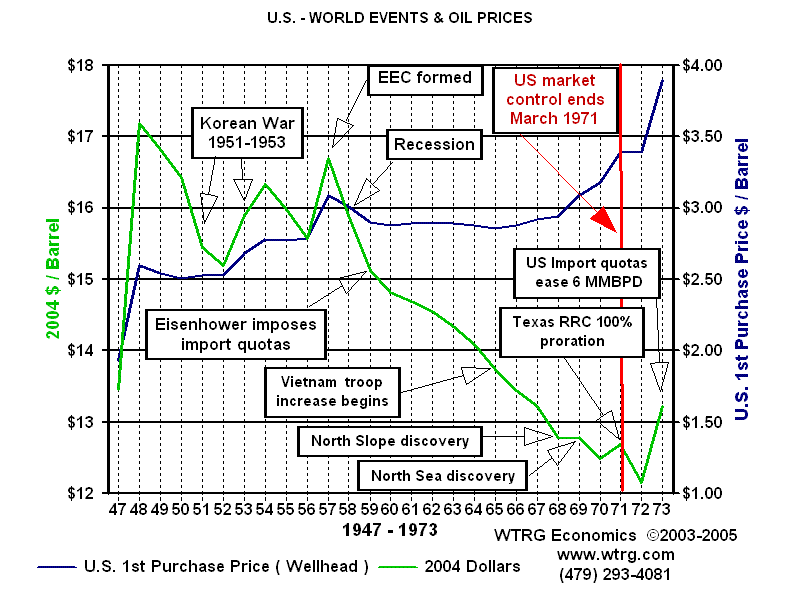
There are many excellent accounts of the history of oil and its pricing, and I can't possibly do justice to this subject in a brief blog posting. If you haven't read the book for which Daniel Yergin won the Pulitzer Prize in 1992, that would be a good place to start. Prior to the first oil crisis, the price of oil was effectively set by the Texas Railroad Commission, which published the monthly quota for production in the state. Together with import restrictions, this constrained supply enough to keep US oil prices between $2 and $4 per barrel. Once the Railroad Commission quota hit 100% in 1971, as a result of growing demand and the peaking of Texas oil output, its influence on prices ended. Oil from the Middle East and other big exporters in that period was sold mainly via long-term contracts, at prices that changed infrequently and that sometimes included "net-back" provisions, explicitly tying the price received by the producer to the revenue realized by refiners in key markets.

All of this changed in the 1970s, after OPEC consolidated its control and began raising the price. It ended net-back discounts and nationalized the holdings of the international oil companies. Between 1972 and 1978, the average price US refiners paid for imported crude oil quadrupled in dollars of the day. The US government intervened in the market by setting the price of "old" and "new" oil--trying to hold down prices while leaving incentives for new domestic production--and limiting imports. These distinctions were exploited by clever traders, and integrated refiners were forced to supply small, independent refiners, even if their own facilities were under-utilized. It was a mess. From 1978-81, in the aftermath of the Iranian Revolution, oil prices increased by another 150%. Over the next few years, OPEC's ability to set prices was eroded by a 10% reduction in global oil consumption and a tsunami of new non-OPEC output from the North Sea, the North Slope and elsewhere. In the ensuing battle for market share, the price of oil fell from its peak of around $40/bbl. to $13, requiring the 1990 Iraqi invasion of Kuwait finally to push it back above $20.

When I traded oil in the late 1980s, most of the US production I dealt with was bought and sold on the basis of the oil companies' posted prices, which solicited offers to sell them lease-level crude output. Alaskan North Slope crude was one of the few domestic grades I handled that was sometimes pegged to the price of West Texas Intermediate crude on the New York Mercantile Exchange (NYMEX.) The prices of the relatively few international cargoes I bought were typically negotiated for each cargo, without reference to other markets. Although I never bought Saudi oil, it was priced by Aramco on two formulas, one for "eastern" and one for "western" destinations. Transparency in that period depended on the ability of reporting services such as Platts to ferret out the details of the transactions that occurred each day. The fewer the transactions, the less reliable these reports were, especially for domestic grades outside the week or so prior to monthly pipeline scheduling, when most deals took place.

History is rarely a perfect guide, but in this case I think it offers some useful lessons concerning how oil might be priced, if the futures markets became less liquid or less influential. Although prices might not be as volatile, day to day, they would be no less prone to manipulation, or to sudden price spikes in response to changes in supply or demand. The pre-NYMEX oil market only yielded low prices when supply was abundant, a characteristic that has been absent since oil prices took off in 2003. Today's problems of transparency, involving the identity and motivation of market participants, pale in comparison to the former challenges of discerning precisely what the day's price was, in the absence of an open, visible exchange platform. I dislike clichés, but as the father of a small child the image of throwing out the baby with the bathwater resonates strongly, here.

Senin, 21 Juli 2008

Changing Our Energy Diet

Over the weekend I participated in a panel discussion on space-based solar power (SSP) at a space-development conference, for the second time in as many months. My presentation focused on what it would take for a new source such as SSP to find a place in our energy diet, which will be changing at the same time that the technology for producing power in space and sending it to markets here on earth develops. The audience of entrepreneurs and space professionals was quite engaged by the idea that SSP couldn't just be a space project; it had to be a viable energy project, too. These same challenges apply to any new energy technology with a long development period, including some that are much more established than SSP. But with politicians, pundits, and experts of all stripes telling us we must rapidly shed our addiction to fossil fuels, the inertia of our present energy diet remains the under-appreciated elephant in the room.

I began my brief remarks with a simple pie-chart showing US energy consumption for 2007, based on data from the Energy Information Agency of the US Department of Energy. As replicated below, it showed the breakdown of our primary energy supply--the raw energy going into power plants, factories, and oil refineries for further processing into fuels, electricity and materials, along with the contribution from nuclear power plants and those energy sources that produce electricity directly, such as hydroelectric dams, solar panels and wind turbines. Despite the recent, breathtakingly-fast growth of wind and solar, and the tremendous success of the nuclear industry at squeezing more output from its 104 existing reactors, the low-emission portion of our energy diet only accounts for 15% of our primary energy needs, and less than a third of our electricity demand, with 93% of that coming from mature hydropower and nuclear sources.

US Primary Energy Supply


As in a diet, not all calories are equal or interchangeable. The 39% of this diet supplied by oil cannot be replaced by renewable sources of electricity without a lengthy and dramatic change in our vehicle fleets, because oil accounts for less than 2% of our electricity generation, and there's very little of it left to displace from the power sector. Nuclear power and natural gas already accomplished that task over the last several decades. The much bigger challenge now is to shift the roughly 97% of transportation energy currently derived from oil to other sources--either electricity in the view of Al Gore, Dr. Andrew Grove and others, or natural gas, as suggested by T. Boone Pickens. But as we make that shift, we can't leave the portions of our economy that will still depend on oil high and dry. We must continue to provide enormous quantities of petroleum, even as we work aggressively to shrink its share of our diet and expand the portion supplied by sources that don't emit greenhouse gases or contribute to our trade deficit. It is fundamental to the nature of oil production that if you don't keep drilling, its supply quickly dwindles.

Tom Friedman's column in Sunday's New York Times drew a parallel between Mr. Gore's ten-year goal for ending our use of fossil fuels and President Kennedy's commitment to reach the moon in a decade. Unfortunately, this analogy breaks down once it gets past the R&D stage. I regard our accomplishment of landing two men on the moon 39 years ago yesterday as the pinnacle of the 20th century. It was a remarkable feat, requiring billions of dollars and hundreds of thousands of scientists, engineers, and support staff of every description, yet it ultimately only put 12 Americans on the lunar surface. We're talking about displacing 85% of the current energy diet of a nation of 300 million people that accounts for between a fifth and a quarter of global GDP. Doing that within a decade wouldn't just be moonshot-impressive; it would require a flat-out miracle.

Jumat, 18 Juli 2008

Farewell to $4?

The price of oil on the New York Mercantile Exchange has dropped $15 per barrel in less than a week, bringing us the first closing price under $130 since June 5. It is premature to suggest that this marks the start of a major correction back to sub-$100 territory, but it's noteworthy that this appears to be happening largely due to the weakening of demand, particularly in the US, where gasoline sales are now down around 3% compared to the same time last year--even more if we adjust for the additional ethanol being blended in under this year's higher Renewable Fuel Standard target. If the oil price stabilized here and refining margins remained weak, the national average retail price of gasoline would shortly drop back below $4.00/gallon. Although that wouldn't mean we'd never again experience prices that high, it would be very interesting to see how a return to the mid-to-high $3 per gallon range would affect consumer psychology.

At the very least, this week's drop should deflate some of the recent oil market hysteria, which was making $200 oil and $6 or $7 gasoline seem like an immediate inevitability, on the strength of little more than self-fulfilling prophesies and jitters about a possible conflict with Iran--something that has had the market on edge since oil was under $50. But while that other mainstay of expensive oil, demand growth in the developing economies, continues apace, the market cannot for long ignore a 3% aggregate drop in petroleum demand from a country that still accounts for nearly a quarter of the world's oil imports. Small fractions of large numbers can have a big impact.

Refiners remain caught in the middle, as they have been for most of the last year. With demand responding to high prices and the soft US economy, refiners are making very little money turning oil into gasoline. Weak demand has forced them to absorb a large chunk of the recent increase in oil prices. Nor does it seem likely they will be able to hang onto more of the margin as oil prices drop, because US gasoline inventories are building at the rate of roughly 2 million barrels per week, despite refiners shifting their operations to produce record quantities of diesel, partly at the expense of gasoline output. Refiners have room to increase crude runs, but at these margins, they are probably better off maximizing distillate and purchasing any gasoline shortfall abroad. But while these conditions have benefited consumers in the short run, they could set the stage for higher product prices in the longer term, by making the economics of refinery expansions less attractive.

After Hurricanes Katrina and Rita, there was a spate of concern about the nation's refining system. No new refineries had been built since the 1970s, and too many were concentrated along the Gulf Coast. All that talk came to nothing, but the exceptional margins that existing refineries were earning for several years kicked off some significant refinery expansions, including the Motiva and Marathon projects in the Gulf Coast that will effectively add the equivalent of a brand new refinery inside the boundaries of two existing facilities--a model currently under consideration by some nuclear plant operators.

Now, this might seem like an odd time to build more refining capacity, with demand falling and over a third of the country convinced that we'll get most of our energy from renewable sources within a few years, according to a new API/Harris Interactive survey. But even if we don't end up using more oil in the future, the kind of oil US refineries can process matters greatly in the global market. Although some analysts are skeptical that Saudi Arabia can deliver on the sustained output increases they have promised, one of the main reasons the market has largely yawned at the prospect of another 2 million barrels per day of Saudi crude is that much of the incremental oil will be of low quality--just the kind that these refinery projects are designed to handle. If refining margins don't recover soon, projects like this could be slowed down or deferred, and additional heavy, sour crude oil production will have less impact on the global price of oil--and that would affect us all at the gas pump.

In the meantime, no one should become complacent, even if average gasoline prices soon fall below $4 for a while--though probably not in California. Global supply and demand remain pretty tightly balanced, and we're now never more than one or two events away from a big spike in oil prices or refining margins. While we might soon spend a bit less at the gas pump, we'd be better off pocketing any savings, rather than turning them into a rebound in fuel demand.